
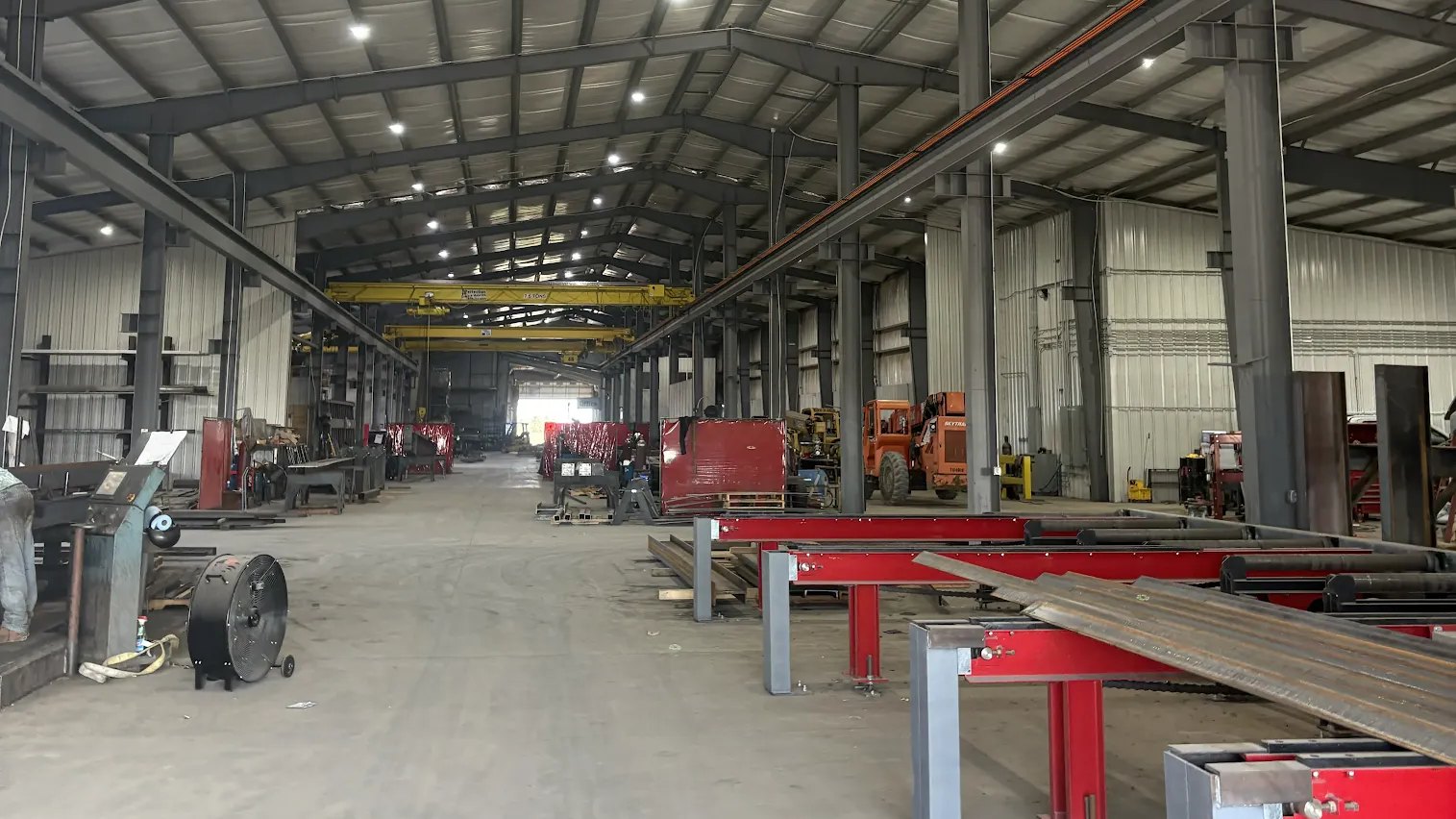
Most shops did not design their floor. It grew. A saw went where the power was. A second welding bay went where there was room. The paint area ended up wherever the overspray bothered the fewest people. Ten years later the steel takes a route through the building that nobody would draw on purpose.
You can feel it without measuring anything. The crane is always busy and somebody is always waiting on it. Fitters walk across the bay for a drawing. A finished assembly gets moved three times before it reaches the truck. Nobody is slow. The floor is making them slow.
You do not need a new building to fix most of it. You need to look at how steel and information move through the one you have.
Start by following one piece
Before you move anything, pick one ordinary beam and follow it from the truck that delivers the raw length to the truck that hauls the finished piece away. Write down every time it gets picked up, set down, or sits.
Fabrication adds value in only a few of those moments: when it is cut, drilled, fit, welded, and coated. Every other touch is handling. Handling costs crane time and labor, and it is where pieces get scratched, mixed up, and lost. An efficient floor is mostly a floor with fewer touches.
Raw material in at one end, finished steel out at the other: receiving, cutting and drilling, fit-up, welding, cleaning and coating, staging, shipping. If your building cannot do a straight line, a U works. What hurts is backtracking, where a piece crosses the bay it already came through and fights the crane for the trip.
Paint the lanes and treat them as off limits for storage. One beam left in an aisle "for a minute" turns a straight forklift run into a detour for the rest of the shift. Clear lanes are also the cheapest safety improvement a shop can make.
Put a marked spot between each station for work coming in and work going out. When the space in front of welding is full, fit-up can see it and stop feeding it. Without marked spots, steel piles up wherever there is floor, and the pile hides the bottleneck from the people who could fix it.
Wire, tips, grinding discs, clamps, and squares belong at the station, not in a crib across the building. Count the walks a fitter makes in an hour for things that could have been within reach. That time is not on anybody's schedule, and it adds up every day.
Finished pieces stacked in the order they came off the floor have to be dug through on shipping day. Stage them by sequence and by truck, with the first piece off at the job site as the last one loaded. The yard should look like the load list.
A remnant nobody can identify is scrap that takes up floor. Mark every usable drop with its shape, grade, and length, and keep them in one rack near the saw. The saw operator should be able to check the rack before cutting into a new length.
Layout is half of it. The other half is harder to see, because it does not sit on the floor. Watch a fitter for an hour and count the stops that have nothing to do with steel: finding the current drawing, asking which piece is next, checking whether a part has been cut, hunting for a piece that is somewhere in the bay.
Each of those is a walk, a wait, or a guess. The same rules apply as for steel. Fewer touches, shorter distances, and nothing sitting in a pile.
Put the drawing at the station
The current revision should be within arm's reach of the person building to it, on paper or on a screen. If someone has to leave the station to find out what to build, the floor is costing you time. If they can build from an old revision without knowing it, the floor is costing you rework.
Mark every piece so anyone can tell what it is
A piece mark that is easy to read, in the same place on every piece, ends most "where is it" searches. A label that can be scanned goes one step further: anyone can walk up to a piece and see what it is, which job it belongs to, and what has been done to it.
Record status where the work happens
If status gets updated at a desk at the end of the shift, the office is planning tomorrow with this morning's picture. When the person who finished the weld marks it finished at the station, the next station knows what is coming, and nobody has to walk the floor to find out.
A walk you can do this week
- Follow one beam from receiving to the truck and count the times it is picked up.
- Stand at the busiest station for 30 minutes and count the walks that are not for steel.
- Find the largest pile of waiting work. The station right after it is your bottleneck.
- Ask three people where a specific piece is and time how long the answer takes.
- Look at the staging area and see whether you can tell which truck each stack belongs to.
An efficient floor is not one where everybody moves faster. It is one where the steel, the tools, and the answers are already where the next person needs them.
Change one thing at a time
Do not rearrange the whole shop over a weekend. Fix the worst thing the walk turned up, run it for two weeks, and ask the people at that station whether it helped. They know where the time goes better than anyone, and a change they suggested is a change that sticks.
Then walk it again. The bottleneck will have moved, and that is how you know the last fix worked.
Put the Information Where the Work Is
FabCommand puts drawings, piece status, cut lists, and load lists on a tablet at each station, with a scannable label on every piece. Start free, no contracts and no sales calls.
Start Free Trial